
And It's Just Monday Morning...
But I'm not sure anything will top Sunday's fun in the sun.

▶I barely got going this morning when I turned on CNBC and saw OpenAI President Greg Brockman’s interview…
The part that got my attention most was the tail end of the interview, when he said, “compute is the new oil…”
And I thought: So was fracking.
Then I saw the story about Nvidia backing a new “another billion here, another billion there” data center being built for OpenAI by Softbank’s SB Energy.
Then I thought: And it’s just Monday morning.
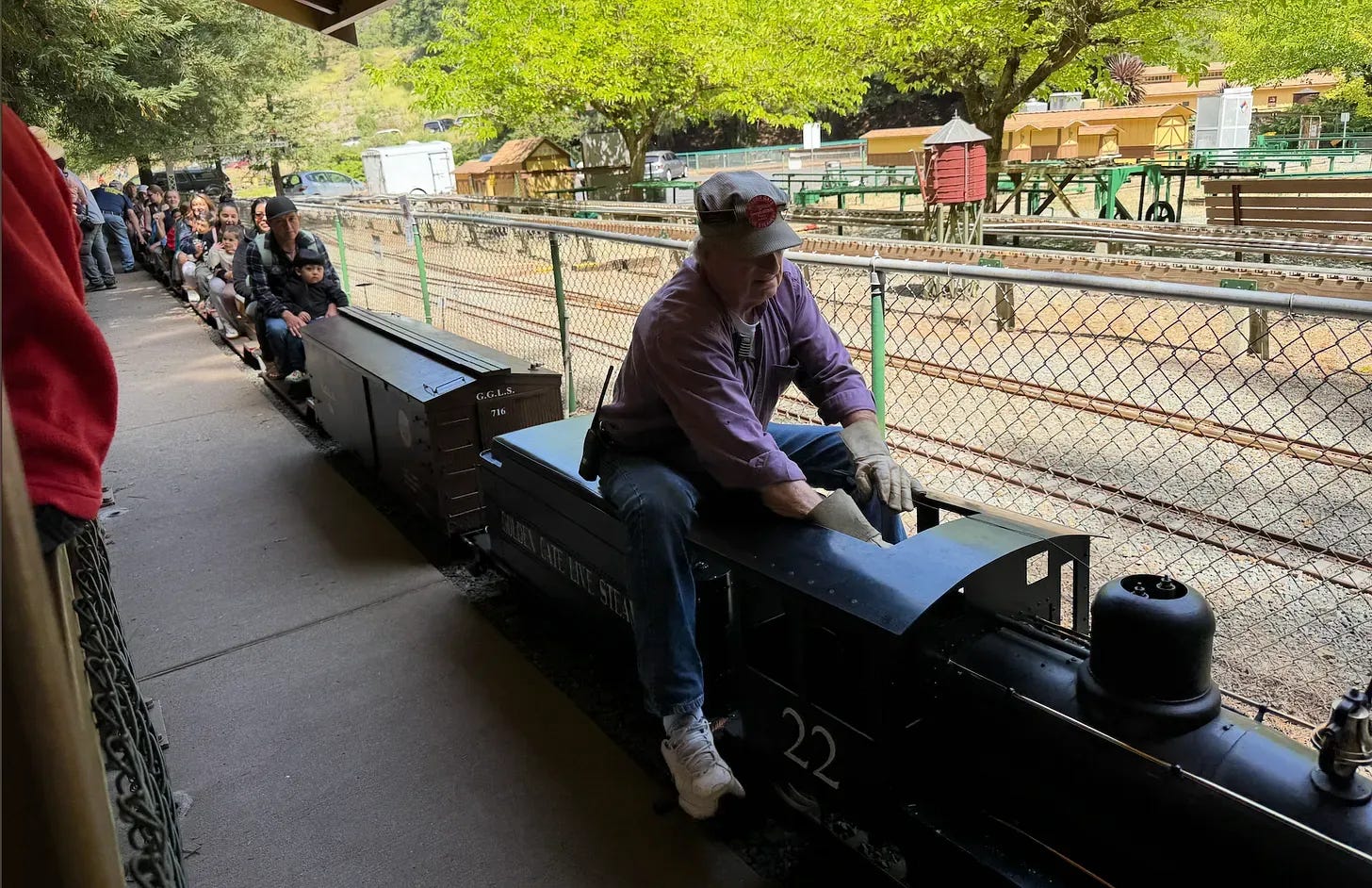
And quite a Monday it is, with my leg propped up as I sit half on/half off a couch after quite an exciting Sunday afternoon at my 4-year-old grandson’s birthday party. This was at the steam trains at a place called Tilden Park in Berkeley. It was the tail end of a three-hour extravaganza, and we were waiting for a fun finish to ride some miniature trains.
Imagine a crowded, narrow, somewhat shaded, damp place waiting 20 minutes with a bunch of four-year-olds who were stuffed with pizza, ice cream, fruit juices, and, well, this was after they had spent a few hours running and playing. They were doing what four-year-olds hopped-up on being four do. To distract from what looked like a possible disaster in the making – when they hear what they want to hear and disregard the rest – I walked over and picked up my grandson and headed back to our space in line. Long story short: In the commotion, as the gremlins scrambled, I tripped over one of them. In fast slow-motion, my grandson and I went straight down.
Yes, he’s okay. As I was falling, I did my best to make sure of that. And I’m – actually better than I should be. I landed on my wrist and my knee. The good news is: My Apple Watch protected my wrist. The crystal is smashed, but hey, it’s still working… and I needed a new one, anyway. And the emergency “you just fell, are you okay?” alert worked like a charm.
My knee? Let’s just say it’s better than last night, and this too shall pass!
But I digress…
The reason for writing today is the Nvidia deal, which seems to harken back to the telecom bubble, when Nortel was the Nvidia of the day – backstopping and lending to all needy customers who needed cash to build out their cable infrastructures.
So I started thinking: I might as well ask AI what it thinks about the correlation. I started with Gemini. Its response…
The parallels between Nvidia’s financial backing of AI data centers and the telecom equipment vendor financing boom of the late 1990s center on vendor-enabled demand creation—using the equipment maker’s balance sheet to absorb risk so cash-constrained buyers can keep purchasing hardware at scale.
The Historical Telecom Playbook (Nortel & Lucent)
—Customer Debt Saturation: Competitive Local Exchange Carriers (CLECs) and telecom startups borrowed heavily to lay fiber and buy routing equipment. When debt markets began tightening, equipment makers stepped in with aggressive vendor financing.'
—Vendor-Financed Growth: Equipment makers lent billions directly to unproven CLECs to purchase their switches and optical gear. This allowed suppliers to book massive current revenue while masking end-market demand constraints.
—The Unraveling: When real-world internet bandwidth demand and consumer monetization failed to ramp quickly enough to service the debt, the CLECs went bankrupt. Nortel and Lucent were left holding bad loans, collapsing their own balance sheets and stock values.
The Nvidia & AI Data Center Parallels
—Capex Exceeding Customer Cash Flow: AI labs and hyperscalers face enormous capex requirements that strain organic free cash flow. To maintain rapid buildout tempos, projects require non-traditional financing structures.
—Circularity and Locked-In Demand: In deals like the SB Energy Ohio complex, Nvidia provides credit backstops and equity capital ($1.5 billion into SB Energy), in exchange for being the exclusive hardware provider for the site’s initial 5 GW buildout. The hardware maker facilitates the project’s debt financing to secure hundreds of billions in future chip sales.
—Monetization Lag: The underlying risk rests on whether end-user software monetization (e.g., enterprise AI adoption) scales fast enough to cover the massive capital costs of gigawatt-scale data centers. If AI compute demand stalls or becomes commoditized, the residual value of the underlying assets drops.
Key Structural Differences
—Asset Backstop vs. Direct Loan: Unlike 1999, where equipment vendors directly issued unsecured loans to customers, Nvidia structures its exposure through backstopping the completed physical data center value rather than guaranteeing ongoing lease payments or writing direct vendor loans.
—Third-Party Capital Insulation: Nvidia increasingly structures deals through external private equity consortia (e.g., Apollo, Blackstone, KKR) to mobilize Wall Street capital rather than bearing the credit risk entirely on its own balance sheet.
—Cash Buffers: Unlike late-90s telecom vendors operating on thinner margins and heavy financial engineering, major players currently hold substantial cash reserves and generate massive cash flow from existing operations.
I then turned to the ever-trusty Uncle Claude, who said…
Largely agree with the core thesis — and the last 72 hours of news actually validate it in real time. Here’s where I’d nuance or update it:
What holds up well
The central parallel — using the vendor’s balance sheet to backstop demand that wouldn’t otherwise clear at this pace — is sound. That’s genuinely the mechanism, and it’s exactly the mechanism critics have started calling “circular financing.” The fact that Nvidia just cut its planned Ohio backstop from $250B to under $120B after investors raised concerns about Nvidia’s risk exposure tied to large financing commitments is close to real-time confirmation of the thesis. Markets are already pricing in the Nortel/Lucent risk the assessment describes.
A few factual corrections/updates
—The $1.5B figure isn’t quite what the assessment implies. That’s not what Nvidia paid for exclusivity on the original 5GW buildout — it’s a newer, separate proposal: Nvidia could commit around $1.5 billion when the agreement for the Ohio data centre is signed, with a further $1.5 billion potentially invested through SB Energy’s IPO, out of a total possible $3B equity stake, layered on top of the credit guarantee, not the mechanism that secured hardware exclusivity.
—The credit backstop and the chip-purchase financing are structured as two separate tracks, not one: Nvidia is also discussing a separate arrangement involving as much as $350 billion in AI chips for the facility, distinct from the data center guarantee — so “the hardware maker facilitates debt financing to secure future chip sales” is directionally right but the two commitments are financially and structurally decoupled, which matters for how each would unwind if something goes wrong.
—The backstop itself just got cut roughly in half and narrowed to the first phase only: Nvidia is now expected to initially guarantee less than $120 billion, down from the $250 billion previously discussed... a financial backstop only for the first phase of the project.
On “Third-Party Capital Insulation” — this point deserves more weight than the writeup gives it
This is the most currently relevant structural difference, and it’s happening in real time: On Aug. 10, Nvidia announced partnerships with Apollo Global Management, BlackRock, Blackstone, Brookfield, Goldman Sachs and KKR to develop financing platforms aimed at raising more than $500 billion in third-party capital for AI infrastructure, with Nvidia potentially backstopping up to $125 billion of that. That’s a meaningfully different risk architecture than Nortel/Lucent writing loans directly off their own books — but note it’s still a guarantee, meaning the credit risk transfer to Wall Street is partial, not full. Nvidia keeps skin in the game.
Where I’d push back slightly
The “asset backstop vs. direct loan” distinction is real but may be doing more work in the analysis than it should. Economically, guaranteeing lease and construction-debt payments behaves a lot like guaranteeing a loan from Nvidia’s credit-risk perspective — if the project can’t service the debt, the guarantee gets called, and Nvidia eats the loss just as Lucent did. The legal structure differs; the tail risk doesn’t differ as much as the framing suggests.
Bottom line
The historical analogy is a reasonable framework, not a stretch, and the fact that Nvidia is visibly de-risking (smaller backstop, spreading exposure to PE/Wall Street, structuring around equity stakes with IPO optionality) suggests Nvidia’s own risk management shares the assessment’s concern, even as it disputes the degree of parallel. The open question the assessment correctly identifies — whether AI monetization scales fast enough to service this capital stack — is the whole ballgame, and nobody, including Nvidia, has resolved it yet.
This is a fast-moving, disputed story with real money on the line — not investment advice, just a rundown of what’s been reported.
I then turned to ChatGPT, which started off saying…
I think the core analogy is strong, but the current version overstates the similarity in a few important places. If this is intended for sophisticated investors, I’d tighten it because someone who knows the telecom history could attack the analogy on technical grounds.
After a long-winded explanation, conclude by saying..
Overall
I’d rate the argument 8/10 conceptually, about 6.5/10 as currently written.
The underlying insight is quite good. But I’d move it away from:
“Nvidia is doing vendor financing like Nortel did.”
toward:
“Nvidia is participating in a modern form of vendor-enabled capital formation that can create demand ahead of underlying economic returns.”
That distinction makes the argument substantially more defensible.
And frankly, “vendor-enabled demand creation” is the phrase I’d build the whole thing around. That’s the genuinely interesting idea here—not another generic “AI bubble resembles 1999” comparison.
At this point it was obvious that the programs were all falling in line to defend their livelihoods.
And not being in any mood to get into a shouting match, I figured I’d play the “ask Elon” card. Grok’s take, after an explanation…
In short, the demand-creation mechanism is analogous, and the monetization-lag risk is genuine. The current structures are more sophisticated, more asset-backed, more intermediated by third-party capital, and supported by stronger corporate balance sheets. That makes a 1999–2002-style cascade less probable, but it does not remove the possibility that a sharp slowdown in AI compute demand or utilization would leave residual values lower than underwritten and force write-downs or capital calls across the ecosystem. The key variables to watch remain utilization rates, offtake contract quality, power and residual-value assumptions, and how much true risk ultimately stays on Nvidia’s (or the private-capital platforms’) books versus being transferred.
At that point, even though it was my first question of the day for Grok – free user that I am – I challenged it… suggesting that as a benefactor to all of this, Grok is biased against seeing the full correlation.
Grok then, in effect, in full Elon mode, told me to go screw myself and refused to answer the question.
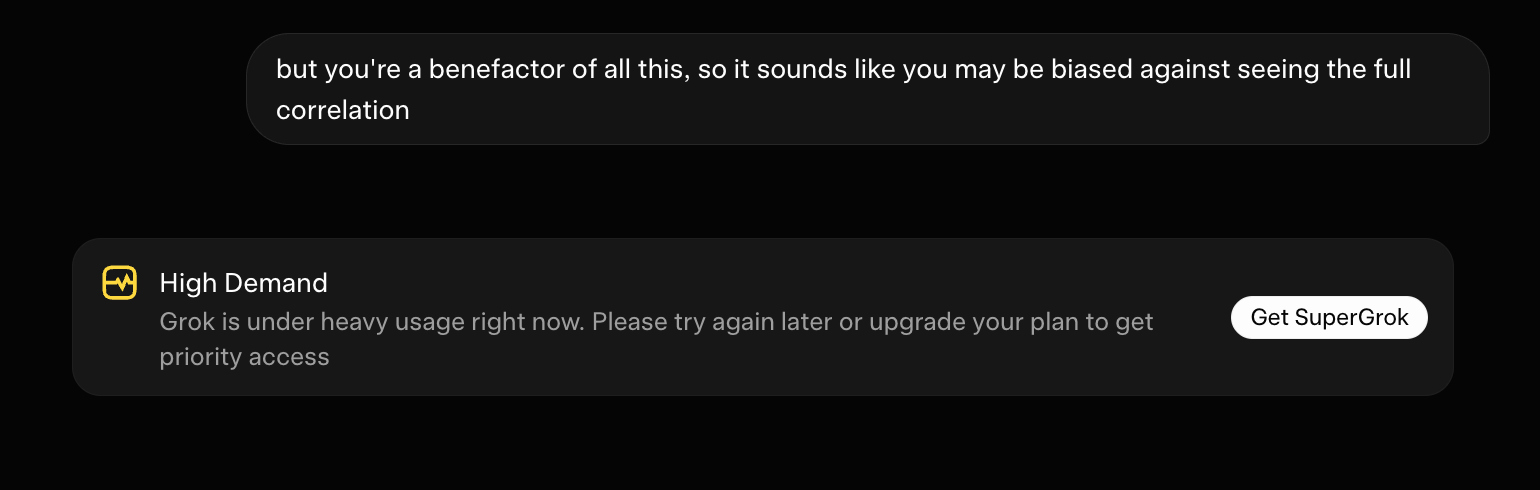
I tried again later, and it wouldn’t budge.
And, no, I’m not upgrading.
That’s my morning; how about yours?
DISCLAIMER: This is solely my opinion based on my observations and interpretations of events, based on published facts and filings, and should not be construed as personal investment advice. (Because it isn’t!) I have no position in any stock mentioned here.
I can be reached at herb@herbgreenberg.com.