
The Wrap – Warning Signs Investors Should Not Ignore
They're often intangible, but the kinds of things that make seasoned investors nervous. Plus, Veeva, Oklo, and... my week of terrible timing.

This is not the time to ignore red flags. Join the large and growing list – portfolio managers, analysts, private investors – who already have signed on as premium subscribers to my Red Flag Alerts for one reason: To understand what could go wrong before – not after – the news hits. Learn more here.
▶Before we get going, this quickie… Just back from a fun few days in Palm Springs. We’ve traveled the world, but for some inexplicable reason, even though it’s a little more than a mere two-hour drive, we have never spent time in “the desert.” And by “time,” since I don’t golf, that means doing what we do when we travel: seeing things.
In Palm Springs, we had a checklist, including a few hours on a date farm with a date farmer, as well as an exceptional architectural tour, both of which Mary will be writing about in her travel blog, “The Modern Postcard.” The only thing we had to cancel was a tour of a wind farm. Actually, they cancelled it because it was too hot. Oh, yeah, we all know the desert is hot, but we picked this time of year because it’s typically before it gets… hot. Except this year, when, in March – still the winter – it was 106 in the shade. Could’ve been worse, had we decided to go to parts of Arizona, where it was 110.
Special thanks to Fiscal.ai, Tenzing MEMO, and ManagementTrack, whose tools were used as part of this research.
Not only was the timing off thanks to unpredictably quirky weather, but it was the same week gas prices shot skyward. Paid $5.79 for premium on the outskirts of San Diego as I was leaving. Then, the next morning in Palm Springs, on our way to hike at Joshua Tree National Park, $5.39 – a bargain!. That afternoon, back in Palm Springs, I noticed the price at the same station had jumped to $5.49. When we left a few days later, the going price was $6.19. Now back in San Diego, I just spotted $6.79… Do I hear $7?
▶Back to business: if you missed my red flag report on ResMed RMD 0.00%↑, you can read it here…

After reading it, one subscriber, who is also a CPAP user, wrote…
I agree with your synopsis in ResMed. I was diagnosed with Sleep Apnea 4 years ago. Speaking to friends, EVERYBODY who takes a “sleep test” suffers from sleep apnea. Someday, Medicare will ask tougher questions.
As a CPAP owner and user, I get phone calls, texts, and e-mails constantly (and I mean constantly) reminding me to re-order the CPAP supplies. As you suspect, they are piling up in the closet.
Talk about a stuffed channel!
▶Moving on, while I was gone, big news on the fraud front: The indictment of Super Micro’s SMCI 0.00%↑ controversial CEO Yih-Shyan “Wally” Liaw, on allegations that he was involved in plans to smuggle Nvidia chips to China. Accounting issues at Super Micro have been a focus of the short-sellers and red flag crowd for more than three years, starting with a report by Spruce Point Management in early 2023, before the stock skyrocketed, and in 2024 by the now-defunct Hindenburg Research. Hindenburg’s report led to investigations by the Justice Department and the SEC. Within a month, the company disclosed that Ernst & Young, its auditor for less than two years, had resigned. But unlike so many auditor resignations, it gave a reason…
We are resigning due to information that has recently come to our attention, which has led us to no longer be able to rely on management’s and the Audit Committee’s representations and to be unwilling to be associated with the financial statements prepared by management, and after concluding we can no longer provide the Audit Services in accordance with applicable law or professional obligations
E&Y’s explanation sparked an internal investigation by “a special committee” of the company’s board.
It wasn’t until later in the saga, when Super Micro announced the special committee’s results, that I took a swipe. Not surprisingly, the committee gave the company a clean bill of health, saying that it couldn’t find what E&Y had.
The crazy part – and the focus of what I was writing – was that – get this: The special committee wound up being a committee of one person. You can read my whole piece here…

I summed it up saying…
Here’s what I know: This story isn’t over yet.
And that’s coming from me. And yes, I am a committee of one.
If ever there was a warning sign, that was it. But even more worrisome for any investor should have been not just E&Y’s resignation, but the fact that it gave a reason.
And that was just the half of it, but it gets to the bigger issue: What are the warning signs that investors should never ignore? Not that any are sure-fire telltale signs that things are guaranteed to get worse. There are, after all, always exceptions. But each suggests something might be amiss and very well may be part of a bigger mosaic worth further investigation.
▶Which gets us to… the main event: warning signs investors should not ignore. I’ve written various “red flag warning” lists of these over the years. When stocks are going straight up, these warnings are often ignored by investors. When they’re going down, as they have been, less so, because as Warren Buffett is fond of saying, when the tide goes out, you can see who is swimming naked.
Or at least who isn’t really swimming at all in what it turns out is only chest-high water…
The latest news out of Super Micro is a reminder that not only are some companies swimming naked, but they can’t really swim.
The trick is figuring out which ones are faking it. Some of the best warning signs are often intangible; it’s more of an art to spot them. Just this week, my pal Bob Howard, of the Positive Patterns newsletter, who has been a stock-picker for decades, ran a list of his favorite warnings. Here it is, reprinted without his permission…
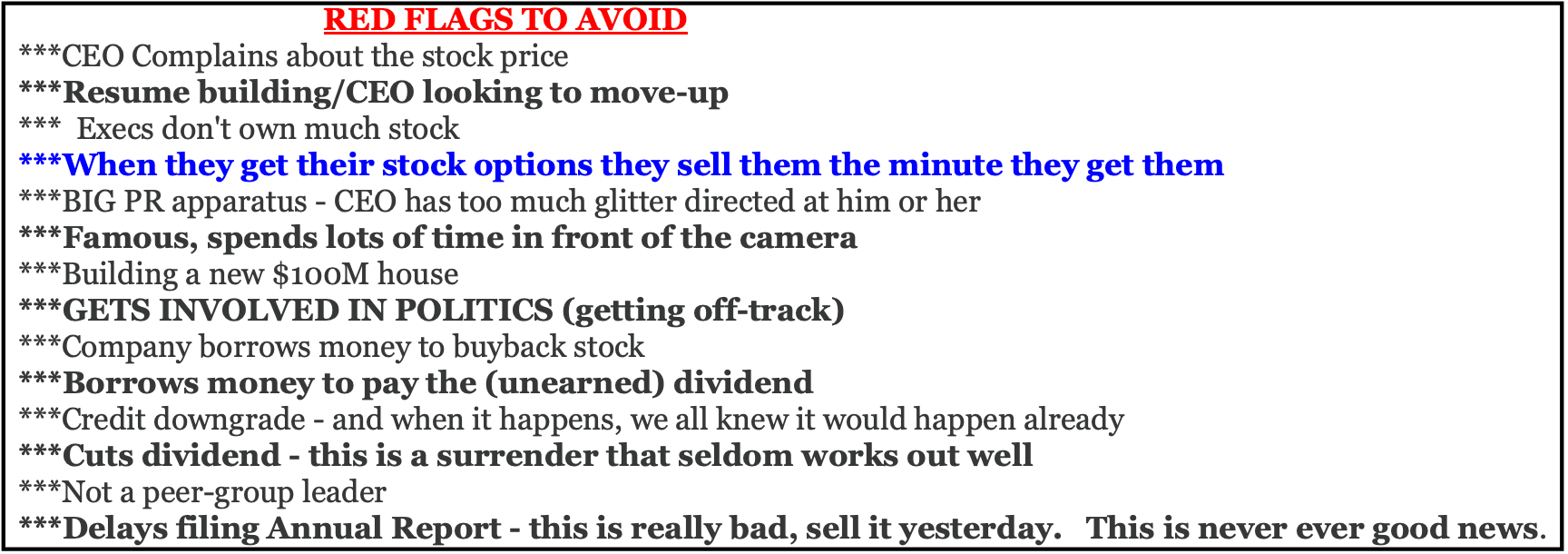
Quite a few of his red flags are on my own list, including a CEO’s focus on the stock price. And an infatuation with being in the media, however it’s defined today. (Says to me they’re either believing their own b.s., or know it is and have stock to sell – so you do, too!)
Others that get my attention…
Press releases touting new big deals, without details. (Lots of that lately in the AI PR swirl.)
Earnings releases with promotional headlines, especially touting “record” results.
Companies that start focusing on made-up metrics.
Companies that slyly begin eliminating various metrics; ditto if slides that have been updated every quarter in an earnings presentation disappear.
The elimination of entire slide presentations by companies that traditionally used them.
The elimination of any kind of guidance. I’m not a fan of guidance, but once a company gets hooked on giving it, especially as it’s growing, the only reason it stops is that its growth is about to, too. (And maybe so are some of the accounting games it may have been playing.)
A change in quarterly or annual SEC filing risk factors that only an investor steeped in the nuances of a company would know is significant. After all, nobody reads those anymore, which makes them perfect to “disclose” things companies might prefer investors not see.
And of course, there’s my favorite: Blaming short-sellers or the media.
The only thing worse is responding to a question about untoward accounting by giving the boilerplate, “Our financial statements were prepared in accordance with GAAP,” often embellished by, “and were audited by our independent auditors.” (See Enron.)
Now, your turn. What are your favorite red flags? Feel free to add them in the comments below or shoot me an email.
▶In other news: a reminder of why, despite the rapid uptake of AI, humans are not about to go extinct… “Check out Veeva’s VEEV 0.00%↑ 10-K,” a friend messaged. It was a classic “go find the needle in a haystack.”
So, I fired up every AI program I use, public and behind paywalls. Using various prompts and then reasking in various ways, I asked them what the most critical changes in the document were, with a special focus on risk factors. They all came up with variations on the same theme, but nothing compelling. Then I went over to CapEdge, my go-to for black-lined filings, and did my own run through… with my eyes. And there it was, as plain as day – and missed by every AI program…
Salesforce, our primary CRM competitor, has announced that certain large Veeva CRM customers have committed to purchasing its CRM solutions and a number of our customers have informed us of their intent to move to Salesforce as their CRM provider.
That bold-faced part is new and material, but rather than blurt it out during its earnings call, the company tucked it into a 10-K risk factor, almost as an afterthought.
That’s the thing with AI… It’s a tool. But without the human element, there’s a strong likelihood the result will devolve into noisy, empty mediocrity.
Which is exactly what’s happening. Spinoffs expert Jim Osman of The Edge Research said it best…
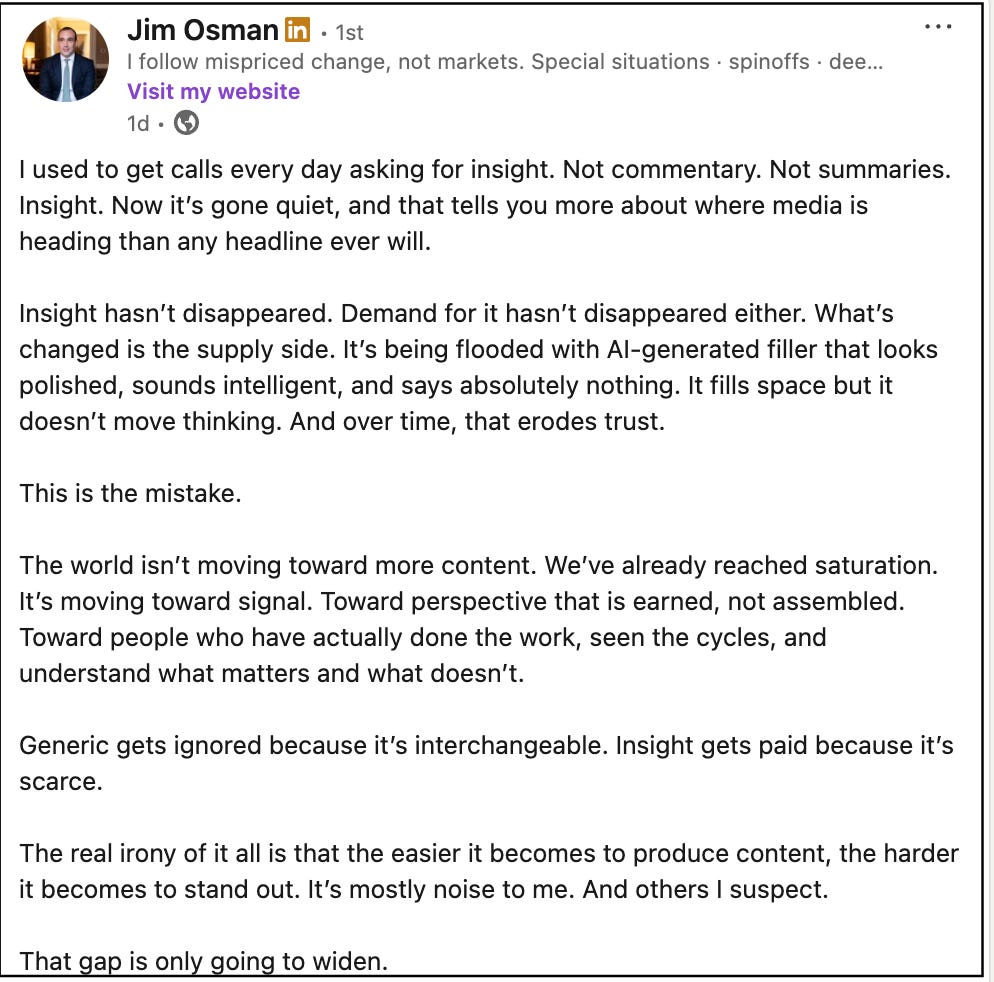
Agreed.
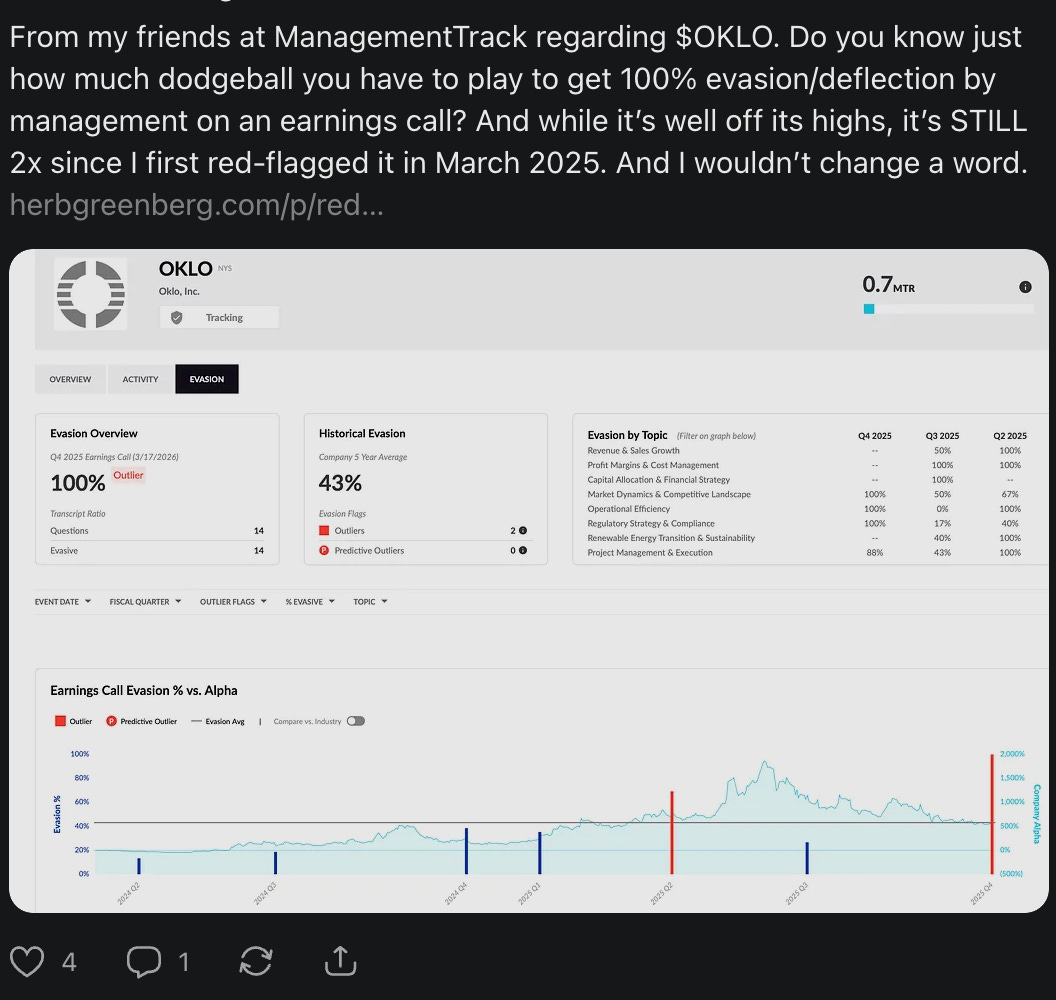
▶Finally, if you missed it…
As always, interpret any or all of this at will.
DISCLAIMER: This is solely my opinion based on my observations and interpretations of events, based on published facts and filings, and should not be construed as personal investment advice. (Because it isn’t!) I do not have any position in any company mentioned in this report.
I can be reached at herb@herbgreenberg.com.
I'd add to your red flags when an auditor is not among top ten auditors, let alone top 100 like CORVEL. I'd also add to your red flags when a substantial number of the executives don't live within the same location as the company's headquarters. In the post-COVID landscape, this is sometimes the case with some executives as I've witnessed with some CFOs but when a majority of key executives are found to live somewhere other than the company's headquarter location, it's another red flag to me as is again the case with CORVEL.
that Veeva 'news' was discussed quite openly on both the latest CRM and VEEV earnings calls