
The Wrap – A Funny Thing Happened On the Way to Cloning My Voice...

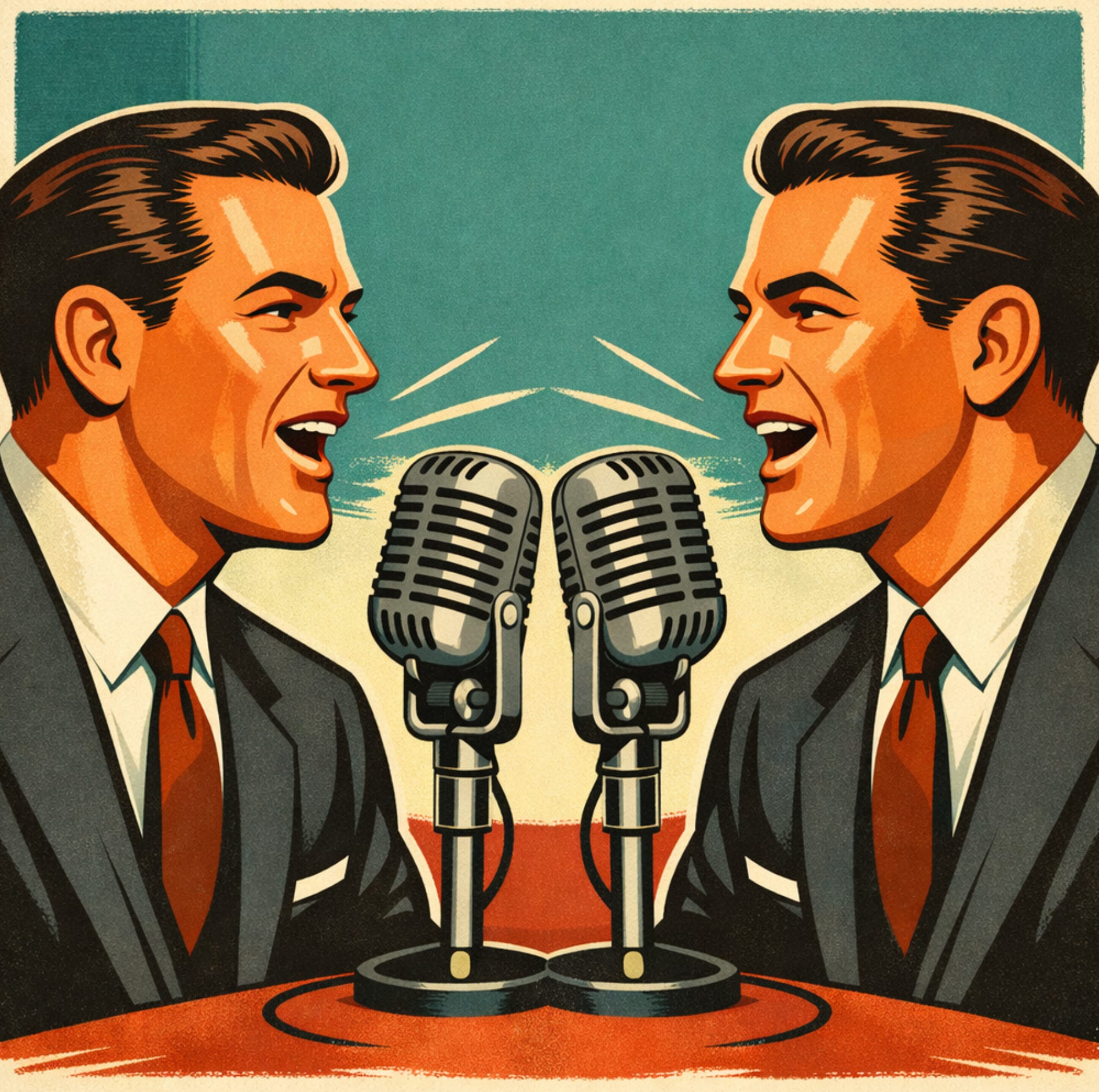
(An audio version of this report is linked lower in the report.)
▶A few quick housekeeping matters…
If you missed my report on Veeva Systems VEEV 0.00%↑you can read it below. It’s since down 7.4%.

Plus, I subsequently had a quick follow-up on Veeva for premium subscribers in chat, which I’m testing for quick updates. I intentionally don’t alert subscribers to those chats with emails, to avoid noise/clutter. If you would rather I do so, let me know.
Starting this week, I’mtesting an audio version of my reports. It seems quite a few people prefer listening rather than reading. Unless the entire report is free, as is this one, these are only for premium subscribers. As a result, most will be behind the paywall, which means given the limitations of Substack, they will be tucked midway through the report. But they’ll be clearly marked and easy to find, similar to today’s, which is below. They’re also available on the new “Audio/Podcast” sections of my website.
Speaking of the audio version, the voice you will hear is me, not a clone. You can check out today’s here…
🎧 Listen to “A Funny Thing Happened On the Way to Cloning My Voice...”
▶Not that I didn’t try to go the cloning route…
Let’s just say: the process is not for novices – at least not if you’re trying to do what I had hoped to do.
Here’s My Story…
I’ve been thinking about adding an audio version or voice-over of my reports for a very long time. With somewhat of a background in broadcasting, I certainly could read each piece aloud. But I also know the reality of then having to edit it.
If there is one thing I’m not, it’s one-and-done when I record something. I typically flub here, stutter there and mumble somewhere else, not to mention swallowing or taking a breath at just the wrong place. It’s either re-record or edit.
I still have PTSD from my days doing pre-recorded weekend “Money Mailbag” segments for KCBS-AM in San Francisco. That was in the 1990s. Not only would I go into a sound booth and do my own recording on reel-to-reel tape. I would then have to edit each one. That meant using a razor blade and splicing tape to cut and splice at the precise millisecond on both ends of the edit… without there being a cracking sound on replay. For a guy who is all thumbs, that would take me hours. Once a week. For 10 years.
Cloning, it seemed, would be the perfect solution – certainly more efficient than me doing it myself.
After doing some research, I settled on Eleven Labs, which is widely regarded as the best of class for cloning.
I had hoped to do this over the holidays, but you don’t clone if your voice isn’t “normal” – and I had a cold.
It’s Showtime
Finally… This past week, I figured that it was showtime.
With Google’s Gemini as my assistant, there to answer all of my questions, I blocked out a full day and went to work. But first, I had to figure out how the Eleven Labs system worked. To say there’s a learning curve would be an understatement... and for a novice like me, it wasn’t as intuitive as I had expected..
THEN I did a bit more than an hour’s worth of recordings. That’s so the system could learn my voice.
THEN I ported them over to Adobe Podcast Studio to “enhance” them by removing a background echo… and it’s pretty cool, because it made my voice sound as though I was speaking into a very high-end microphone... rather than the AirPods I was using.
THEN I excitedly imported the enhanced audio back into Eleven Labs, waiting for the moment of truth…
Long story short, after some fiddling around, I was blown away by the results. It really sounded like me – not a computer.
THEN came the reality: As I listened, I wanted to tweak it… changing a word here and there or even a sentence. Writing for readers is one thing; writing to be heard, another. Worse, it mispronounced company names… and let’s not get started on acronyms… or even years. I think my final straw was the year 2025 pronounced as “two thousand-twenty five.”
That’s when I realized… this thing ain’t for me.
Losing the Authenticity
Each time I tried to make a change in the transcript, it would produce a full regeneration of my voice… and each time, it would sound different. The more research I did, the more I realized sounding like my voice is one thing; sounding as if I actually was doing the heavy lifting – another.
What’s more, cloning missed the authenticity of my inflections. And I do have inflections. And while it sounded really good, it was void of my character. It appeared that to do this right – short of hiring a producer – would require learning codes to insert in the text to get it even better... and spending considerably more time than I was willing to give it.
What I really needed was a program that would let me easily change the script on the fly by removing and adding words or sentences – in my voice – with the stroke of the keys on my keyboard.
As it turns out, and as I learned, Eleven Labs is built for serious cloning of entire scripts. You can’t just change a word in the transcript, without a bunch of dominoes falling – resulting in a broad regeneration of my voice over parts of the script… often taking something that sounded pretty good and making it sound awful. And in the process, using up a lot of your allotted monthly “credits,” with each change draining the credit bank.
Finding An Easier Way
I then took a closer look at Descript, which I’d originally heard about from my son-in-law, who used to work there. A few years ago, he had shown me how easy splicing and dicing was... and how it was a far cry from my radio days.
What took me more than a few hours to try to attempt to figure out with Eleven Labs took an hour with Descript.
Which gets us to where we are today. If you go the “listen” route, let me know what you think!
And for what it’s worth: Ironically, while I was in the thick of doing this an article from tech journalist Casey Newton, who writes the Platformer newsletter, hit my inbox. It was about how he had just used Eleven Labs to clone his voice… and to create audio versions of his newsletters. I don’t know what he sounds like normally, but what I heard sounded quite good. He did say it missed a lot of his rhythms and mispronounced things, but that it’s good enough for him... and much better than earlier versions he tried.
For me, so far I’ve found it much easier to record my own voice and edit it on Descript. It may not be perfect, but it’s me, not a clone.
What will I ultimately do? Well... if it turns out nobody listens to these things, I’ll just let them fade away. In the meantime, I still have a few weeks and a bunch of credits left on my Eleven Labs subscription. Which means, the experiment continues.
DISCLAIMER: This is solely my opinion based on my observations and interpretations of events, based on published facts and filings, and should not be construed as personal investment advice. (Because it isn’t!) I currently have no position in any stock mentioned here.
I can be reached at herb@herbgreenberg.com.
Audio versions of tightly written reports are fine, maybe even good. What I hate are people who do a 30 minute show in audio or video. It’s a lazy way to convey an idea and usually there’s maybe 5 minutes of information spread out over 30 minutes.